In the field of polymer processing, twin-shaft melt pumps have become essential equipment for enhancing production efficiency and product quality thanks to their unique design. This article provides an in-depth analysis of their core advantages from three key perspectives—mechanical performance, conveying performance, and operational stability. Drawing on the technical expertise of leading companies such as Zhengzhou Bate, it highlights their outstanding performance in high-end applications such as HDPE double-wall corrugated pipes.
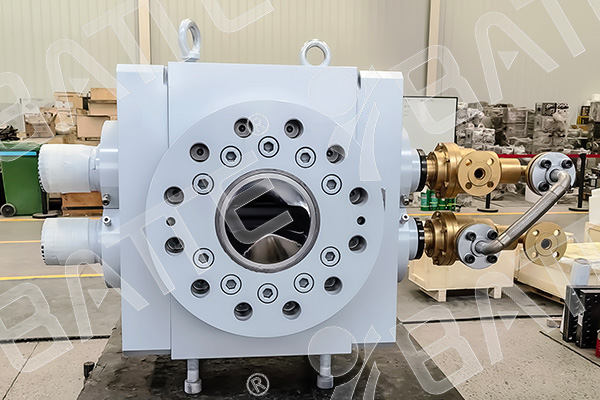
1. Mechanical Performance Advantages: Dual-Shaft Synergy, Doubled Service Life
In traditional single-shaft pumps, gear bearings must simultaneously withstand radial forces and torque loads. Long-term operation can easily lead to fatigue wear, affecting equipment lifespan. In contrast, dual-shaft melt pumps utilize a synchronous counter-rotating design, allowing the radial forces on the two shafts to cancel each other out, so that the gear bearings only need to bear the torque load. This innovation significantly reduces the load on each shaft, minimizes the risk of fatigue failure, and extends equipment lifespan by over 30%. The reliability of dual-shaft pumps is particularly evident in continuous HDPE double-wall corrugated pipe production lines. For example, a case study from Zhengzhou Bate demonstrates that their equipment can operate continuously for over 8,000 hours without failure, significantly reducing maintenance costs and the risk of production interruptions.
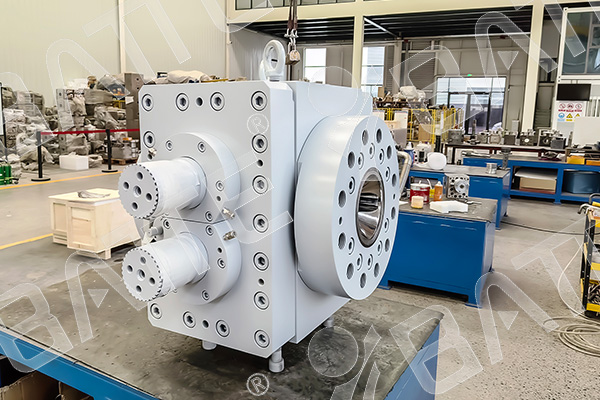
2. Advantages in Conveying Performance: High-Pressure Feeding, Efficiency Leap
The symmetrical flow channel design of the twin-screw melt pump significantly enhances volumetric efficiency. At the same rotational speed, flow rates are 20%–40% higher than those of single-screw pumps, with output pressure stability maintained within ±0.5%. Its precision gear meshing effectively reduces internal melt backflow, significantly improving conveying efficiency. This feature is particularly suitable for the production of large-diameter, thick-walled pipes, as it rapidly meets the die’s demand for high-pressure melt feeding.
3. Operational Stability: Pulsation Suppression, Quality Assurance
The symmetrical dual-shaft layout, combined with high-precision gear machining, completely eliminates the flow pulsation typical of traditional single-shaft pumps. Actual test data shows that pressure fluctuations are ≤1%, far lower than the 5%–8% typical of single-shaft pumps. This stability effectively protects downstream die heads and piping, preventing uneven product wall thickness caused by melt pulsation.
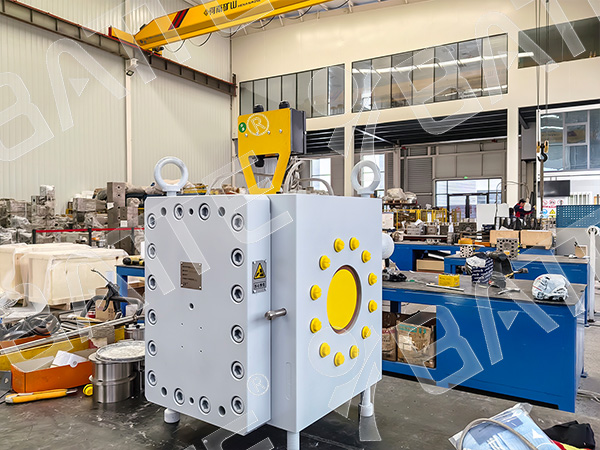
The advantages of dual-shaft melt pumps extend beyond equipment performance to directly translate into production benefits. For example, in HDPE pipe production, when used in series with an extruder, they can reduce backpressure by 40% and increase output by more than 20%, making them particularly suitable for applications requiring high dimensional accuracy, such as municipal water supply and drainage pipes and chemical transfer pipes.
Email: sale@meltpump.com
WhatsApp: +86 158 3833 1071